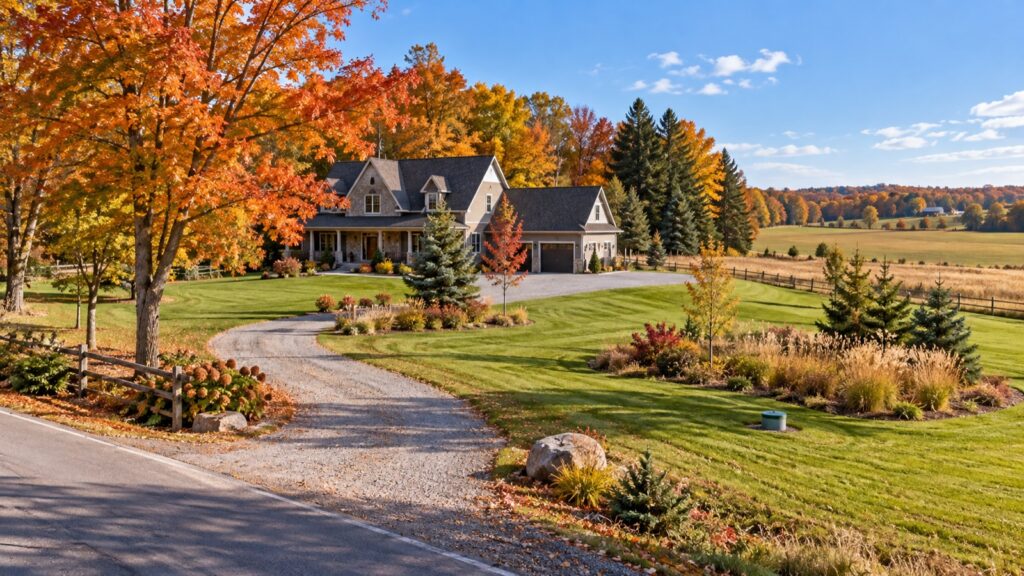
Rural Clarington can offer the space many buyers imagine when they decide to leave a denser neighbourhood: a longer driveway, mature trees, room for a workshop and a quieter setting outside Bowmanville, Newcastle, Courtice or Orono.
The trade-off is that a country property may ask the homeowner to manage systems that a serviced urban home does not. The house is only part of the purchase. The well, septic system, drainage, access and land-use rules can have an equally large effect on cost and daily life.
Confirm how the property is serviced
Do not assume a rural address has municipal water or sewers. Many properties rely on a private well and an onsite septic system. Your offer, inspections and document review should reflect the actual servicing at that specific address.
Ask for available well records, septic permits, pumping receipts, maintenance information and any reports completed for previous transactions. Missing paperwork does not automatically make a property unsuitable, but it does mean the buyer needs a clear investigation plan.
Test the well, not just the kitchen tap
A tap that runs during a showing does not establish water quality or long-term supply. Buyers should discuss bacteriological testing, water chemistry and flow or recovery testing with qualified professionals. The right scope depends on the property, the well and any nearby land uses.
Durham Region offers free bacteriological testing for private well water and provides local sample bottle pickup and drop-off information. A standard bacterial sample is important, but it does not test for every possible chemical or mineral issue.
Ontario’s well guidance also makes clear that the owner is responsible for maintaining the well and properly abandoning it when necessary. Locate the active well, confirm the type and age where possible, and ask whether unused wells exist on the property.
Understand the septic system
A septic system treats household wastewater on the property. Its condition depends on design, installation, soil, usage and maintenance. Ask when the tank was last pumped, where the tank and leaching bed are located, and whether additions, decks, pools, gardens or heavy vehicles have affected the system area.
Durham Region says its Health Protection Division holds septic records for Clarington and most other Durham municipalities. The Region’s septic information explains the records and inspection context. Buyers should consider a qualified septic inspection instead of relying only on a seller’s recollection.
Future plans matter too. A renovation or addition can change expected wastewater flows, and the existing system may not support the new design. Confirm feasibility before treating extra square footage as automatic.
Check conservation and natural hazard constraints
A beautiful creek, wetland, slope or wooded area may be part of the appeal, but it can also affect what can be built and where. Ontario explains that conservation permits help protect people and property from hazards such as flooding and erosion and may be required in addition to municipal approvals.
Before planning a new garage, pool, addition, driveway crossing or major grading project, determine whether the property falls within a regulated area and speak with the appropriate municipal and conservation staff. Do not rely on a neighbour’s project as proof that the same work will be permitted on another parcel.
Ask about municipal drains and water movement
Rural drainage is easy to overlook because a municipal drain may not appear on title in the way a buyer expects. Ontario advises prospective purchasers to contact the municipality to determine whether a drain affects the property or whether assessments apply.
Walk the land after rain if possible. Look for standing water, erosion, blocked culverts and low areas near buildings. Ask where spring runoff travels and whether the driveway, basement or septic area has flooded.
Review access, snow and everyday logistics
A long rural driveway is charming in October and a real maintenance responsibility in February. Confirm who owns and maintains the road, how snow is handled, whether emergency and service vehicles can access the house and where garbage and recycling are collected.
Also test the practical items that affect daily life: internet options, cellular coverage, fuel source, generator setup, propane tank ownership, insurance availability and travel time to schools, groceries and medical services.
Build the offer around the property
A strong rural purchase is not about finding reasons to walk away. It is about identifying the systems and constraints early enough to make an informed decision. The appropriate conditions may include financing, insurance, well testing, septic inspection, home inspection, document review and professional advice tailored to the land.
Rural Clarington can be a rewarding place to live, but the best experience starts with understanding what you are taking responsibility for. When the investigation is thorough, the space and privacy feel like benefits rather than surprises.
Thinking about buying or selling in Port of Newcastle or Clarington?
Brandon Hebert
Realtor, The Hebert Group, RARE Real Estate Inc., Brokerage
Port of Newcastle and Durham Region
brandon@thehebertgroup.ca
416-949-7529
Written by Brandon Hebert, The Hebert Group, Port of Newcastle real estate specialist.
Written by Brandon Hebert · The Hebert Group · Port of Newcastle Real Estate Specialist
Questions About the Newcastle Market?
I'm your local resource. Let's talk. no pressure, just real insight.
Work With Me