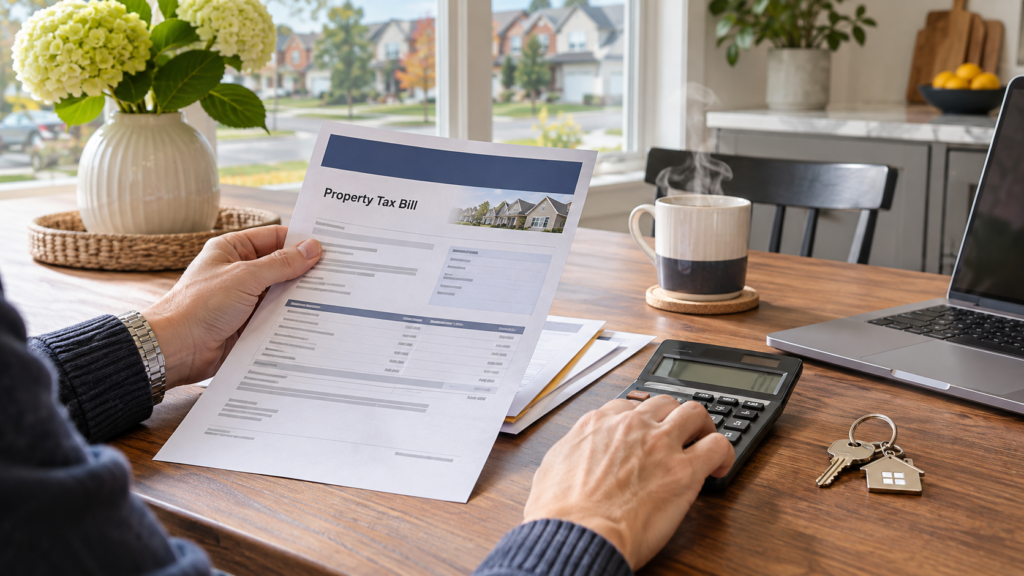
Property taxes are one of the largest ongoing costs of owning a home, but they are often reduced to a single number in a listing. Buyers in Newcastle, Bowmanville, Courtice, Orono and rural Clarington should understand where that number comes from, what can change after closing and why a newly built home can produce an unexpected bill later.
The goal is not to memorize a tax formula. It is to know which documents to request, which number to use in your monthly budget and which questions belong with your lawyer or Clarington Taxation Services before you remove conditions.
How Clarington property taxes are calculated
A residential property tax bill is based on the property’s assessed value multiplied by the applicable tax rates. MPAC, the Municipal Property Assessment Corporation, determines assessed values across Ontario. The final bill combines municipal, regional and education portions.
Clarington’s 2026 residential and farm combined rate is 1.419218%. That rate includes a Region of Durham portion of 0.780760%, an education portion of 0.153000% and a Clarington portion of 0.485458%.
A simple illustration using the 2026 rate would be:
- $400,000 assessed value: about $5,677 annually
- $500,000 assessed value: about $7,096 annually
- $600,000 assessed value: about $8,515 annually
These are mathematical examples, not estimates for a particular home. The assessed value used for taxation may differ significantly from the current market price.
Assessed value is not the same as sale price
A home selling for $800,000 does not automatically receive an $800,000 assessment. Market value is the price a buyer and seller agree on today. Assessed value is the figure MPAC uses within Ontario’s assessment system.
This distinction matters when comparing two properties. A lower asking price does not always produce a lower current tax bill, and a higher sale price does not mean the tax bill changes immediately to the purchase price. Buyers should review the actual tax bill and assessment instead of applying the tax rate to the listing price and assuming the result is exact.
What to verify before making an offer
- Ask for the most recent final property tax bill, not only the MLS figure.
- Confirm the assessed value and property class.
- Ask whether taxes are fully paid or whether there are arrears.
- Check whether the property has undergone a recent addition, severance, conversion or new construction.
- Ask your lender whether property taxes will be collected with the mortgage payment or paid directly by you.
Your lawyer will normally handle the tax adjustment on closing. If the seller has prepaid taxes beyond the closing date, the buyer reimburses the seller for the appropriate period. If taxes remain owing, the adjustment works in the other direction.
The biggest surprise: supplementary bills on new homes
Clarington warns buyers of newly constructed homes that they may initially receive a bill based only on the vacant lot. After MPAC assesses the completed house, the municipality issues a supplementary bill for the building value. The process can take up to two years and the bill can be retroactive to the purchase date.
That means a low initial bill on a new home should not be treated as the permanent annual cost. Clarington recommends contacting Taxation Services to help estimate the future amount based on the purchase price. Setting aside money each month can prevent a retroactive bill from becoming a household emergency.
How the bill supports local services
Clarington’s budget information explains that the overall bill supports three levels: the Municipality of Clarington, the Region of Durham and education. Municipal and regional services include roads, snow clearing, fire and emergency services, parks, libraries, waste programs, transit and other infrastructure and programs.
The municipality’s 2026 budget update estimated an average overall increase of 1.76%, or about $56.40 annually for an average residential property. Your own change depends on the property’s assessment and classification.
Build the right monthly number
Divide the verified annual tax amount by 12 and include it beside the mortgage, utilities, insurance and maintenance. If you are buying new construction, use an estimated full assessment rather than the lot-only bill. If you are choosing between homes, compare total monthly ownership costs instead of focusing only on purchase price.
Property taxes are manageable when they are verified early. The risk comes from relying on an old listing number, confusing assessment with market value or treating a partial new-home bill as permanent.
Official resources: Clarington Property Taxes and Assessments and the 2026 Final Tax Rates.
Thinking about buying or selling in Port of Newcastle or Clarington?

Brandon Hebert
Realtor · The Hebert Group · Port of Newcastle & Clarington
Written by Brandon Hebert · The Hebert Group · Port of Newcastle Real Estate Specialist
Questions About the Newcastle Market?
I'm your local resource. Let's talk. no pressure, just real insight.
Work With Me